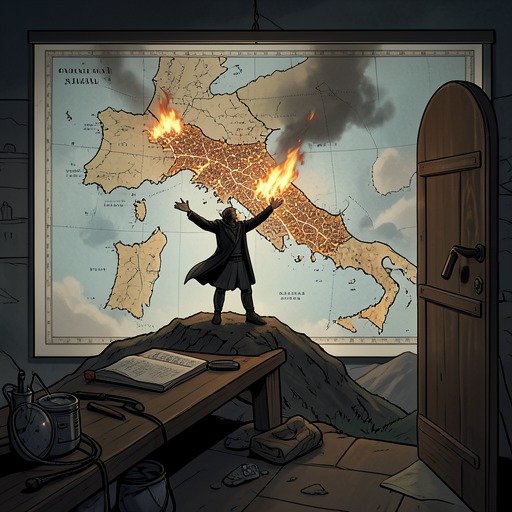
Sicilian Constitution of 1812
The Florios of SicilyThe Sicilian Constitution of 1812 was a reform charter born of revolt against Bourbon taxation. Drafted on the Westminster model, it sharply reduced the king’s power, prescribed the abolition of fiefdoms, and sought to modernize Sicily’s government. Its brief life ended with the 1816 union of the kingdoms of Naples and Sicily: annulled by Ferdinand I, it became a reference point for the island’s lost autonomy and for the recurring conflict between political authority and control of Sicily’s resources.
Revolt and Constitutional Reform
In 1812, a revolt broke out in Sicily in response to an income tax imposed by Ferdinand IV. The government answered the crisis by promulgating a constitution modeled on the Westminster system. Its provisions reached beyond taxation: they practically stripped the Bourbon king of power, called for the abolition of fiefdoms, and reformed the apparatus of government. Reform was tied to a broader ambition to modernize Sicilian society and strengthen the island’s connection with Britain, whose interests included keeping Sicily independent.
The charter’s significance therefore rested both on its institutional design and on the political circumstances that made it possible. It offered a framework for limiting royal power and changing a feudal order, while aligning those reforms with the strategic value Britain placed on an independent Sicily. That independence, however, remained vulnerable to the changing balance of power among the Bourbon monarchy, Naples, and foreign interests.
Annulment and Bourbon Rule
The constitutional settlement was overturned on December 8, 1816, when the king staged a coup to unite the kingdoms of Naples and Sicily under one banner, taking the name Ferdinand I, King of the Two Sicilies. He annulled the 1812 constitution. Under the resulting order, Sicily was treated as a colony and subjected to a harsh tax regime.
The political reversal had immediate administrative and commercial consequences. From December 1816, Neapolitans administered state offices and customs and held military commands; Palermo was left without power or independence. Heavier taxes, trade restrictions, and new constraints compounded an already faltering economy until it came to a complete halt. The constitution’s abolition was thus not merely a change in royal arrangements: it accompanied the transfer of control over the island’s administration and commerce.
The Charter’s Material Afterlife
The novel connects political rules to the practical conditions of business. The Florios’ spice trade depended on customs administration: they stored goods in a warehouse within the Palazzo Steri property and paid import tariffs only when the goods entered Palermo, rather than while they remained in transit. This arrangement, common among wholesalers, helped them manage costs and move spices sourced through British and French colonial trade. Customs policy was not distant constitutional background; it shaped the risks and opportunities of commerce.
Regime changes repeatedly unsettled that commercial world. During the 1848 revolution, authorities blocked outgoing ships and customs activity stalled amid plans for a provisional government. Vincenzo Florio later told Giulia that he had bought rifles in England for the revolutionary committee, while his ships had been requisitioned and he had been practically forced to make a loan. Trade had fallen by half; the Sicilian Steamship Company’s Palermo had been taken by the revolutionary regime to transport troops. These events echo the earlier constitutional crisis: competing governments asserted authority by controlling customs, shipping, credit, and military transport, drawing merchants into political struggles even when they sought to protect their businesses.
The same tension returns after unification. Vincenzo orders all the cash and bank drafts under his control as a trade governor transferred into a safe during the crisis, intending for the funds to return to circulation or be converted into the kingdom’s new currency when conditions allowed. Later, he condemns the Piedmontese for treating Sicily as a colony and objects that the Bourbon Crown treasury has been taken to Piedmont to pay for annexation. Against these reversals, the 1812 constitution stands as an earlier, short-lived attempt to limit centralized power. Its history gives the novel’s political argument a material measure: sovereignty is experienced through who governs, but also through who taxes trade, controls customs, requisitions ships, and commands money.